
2026-09-01 · Dave Hendricks
How to Get Your Heat Pump Ready for a Mahnomen County Winter
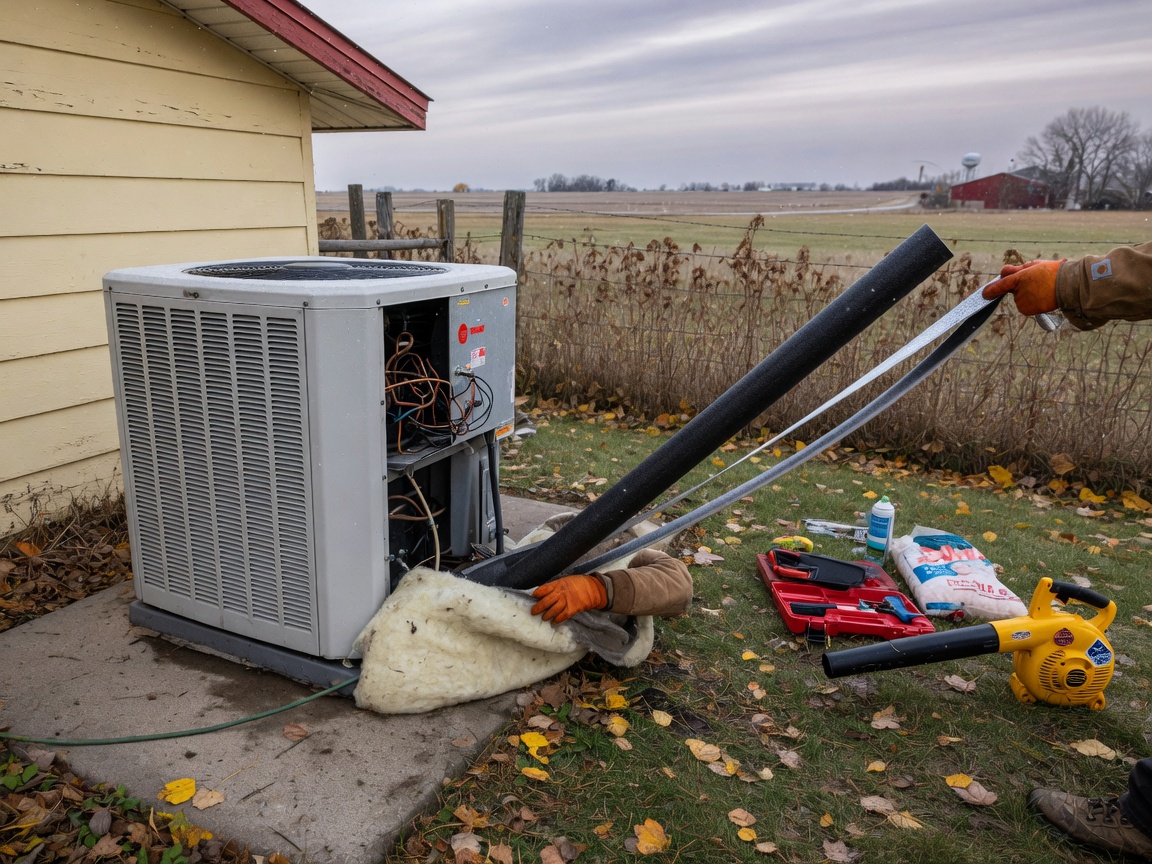
First, a clarification that saves a lot of confusion: you don't winterize a heat pump the way you'd put an air conditioner to bed. A heat pump heats your home in winter, so covering it, wrapping it or shutting it off defeats the purpose and can damage it. What you want is to prepare it for our winters, so it keeps running efficiently through snow, ice and cold, and so it hands off smoothly to your backup heat when it needs to. Here's how.
1. Get a fall tune-up
A heat pump works in both seasons, so it deserves a check in both. The fall visit is about heating: testing the defrost board and sensor, the reversing valve, backup heat staging, the dual-fuel switchover (if you have a furnace backup), and the refrigerant charge. A small undercharge you'd never notice in July can cost real heating capacity at 5 degrees. We'll also clean the coil and clear the base pan. See Heat Pump Services.
2. Make sure the unit is up off the ground
When a heat pump heats, it periodically runs a defrost cycle to melt frost off the outdoor coil. That meltwater has to drain away. If the unit sits on a low pad at ground level, the water pools, refreezes and builds up into a block of ice under and inside the coil. In Mahnomen County, where we get deep snow and long subzero stretches, outdoor heat pump units should be on a stand or wall bracket above the typical snow depth, with a clear path for water to drain. If yours is sitting low, it's worth raising before winter.
3. Keep it out from under the roof drip line
A heat pump right below a roof edge without gutters gets hammered all winter. Snowmelt drips onto it and freezes, and chunks of ice slide off the roof and dent the fan guard or coil. If you can't move the unit, a small roof diverter or a protective top panel (open on the sides, never a full cover) can help. Just make sure nothing blocks airflow through the coil or the fan discharge.
4. Clear space around it, and keep it clear
Before the snow flies, clear leaves, grass, weeds and anything stored near the unit. Keep at least two feet of clearance on all sides. Through the winter, after each storm, brush snow away from the sides and top, and clear drifts so air can flow. Use a soft broom, never a shovel edge or anything sharp against the coil fins.
5. Don't cover it
This is the most common mistake we see with heat pumps. A plastic cover or tarp blocks airflow, traps moisture and invites mice. On a heat pump it will also stop the system from heating. Leave it uncovered.
6. Check your thermostat and backup heat settings
Most heat pumps around Waubun are set up as dual-fuel systems with a propane or electric furnace as backup, or with electric auxiliary heat strips. A few things to check:
- Know what "Emergency Heat" does. It shuts off the heat pump and runs only backup heat. It's meant for when the heat pump has failed, not for cold days. Leaving it on runs up your propane or electric bill.
- Check the switchover temperature on a dual-fuel system, the outdoor temperature where the furnace takes over. It should reflect your fuel costs and your house. If you're not sure what it's set to, we can check and adjust it.
- Avoid big setbacks. With a heat pump, dropping the thermostat 8–10 degrees overnight and cranking it back up in the morning often triggers backup heat to make up the difference. Small setbacks or a steady temperature usually cost less.
7. If you're on Wild Rice Electric's off-peak program
Many Mahnomen County homes use Wild Rice Electric's off-peak heating program, which gives a reduced rate for electric heat that can be switched off during peak demand, while a backup system carries the house. If your heat pump is part of that setup, make sure your backup furnace is serviced too. During control periods, often the coldest days of the year, it has to start reliably after possibly sitting unused for weeks. The co-op's program also requires keeping a supply of backup fuel on hand, so keep an eye on the propane tank.
8. Know what normal looks like in winter
Heat pumps behave differently from furnaces, and some normal winter behavior surprises new owners:
- Light frost on the outdoor coil is normal. The defrost cycle clears it.
- Steam rising from the unit during defrost is normal. That's frost melting.
- A whoosh or brief pause when it switches in and out of defrost is normal.
- Air from the registers feels warm but not hot. Heat pump air is cooler than furnace air, but it runs longer and keeps the house even.
What's not normal: a unit encased in solid ice that never clears, a heat pump blowing cold air for long periods, backup heat running constantly in mild weather, or a fan that won't spin. Those need a technician.
When to call
If your heat pump is icing up, not keeping up, or not handing off to backup heat on cold nights, call Waubun HVAC Pros at (218) 227-4357. We're based on 1st St in Waubun, and we answer heating emergencies 24/7. If you're still deciding whether a heat pump makes sense for your home, read Are Heat Pumps Worth It in Minnesota?