
2026-09-01 · Dave Hendricks
Furnace Not Working After a Cold Snap? A Waubun Homeowner's Troubleshooting Guide
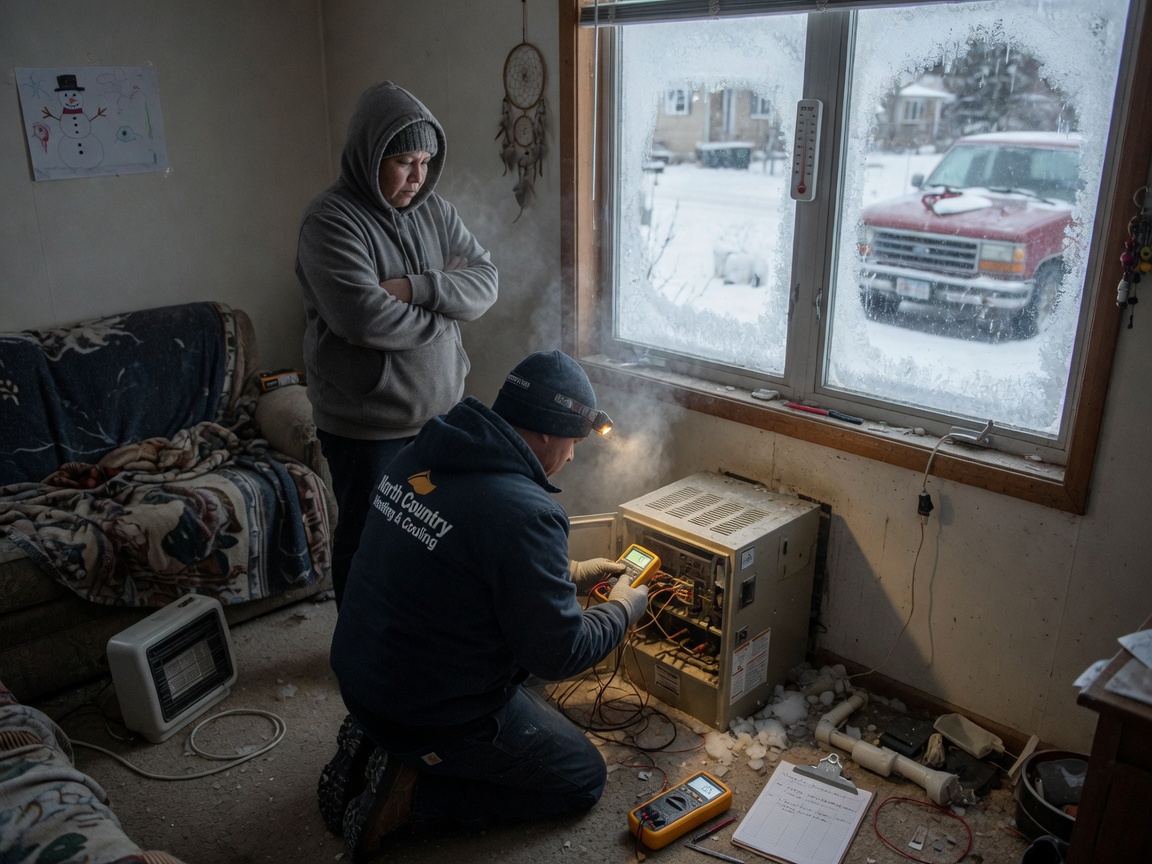
Every winter follows the same pattern around Waubun. The first week of real arctic air arrives, overnight lows drop to 15, 20 or 25 below, and furnaces that ran fine all fall suddenly quit. Some of those calls need a technician and a part. But a surprising number come down to something a homeowner can check in five minutes. This guide walks through the checks we'd ask you to do on the phone, in the order we'd ask, plus what to do to keep your pipes from freezing while you wait.
Safety first: If you smell gas, leave the house and call your gas or propane supplier from outside. If a carbon monoxide alarm is sounding, get everyone out and call 911. Don't try to troubleshoot either one yourself.
1. Check the thermostat
It sounds too simple, but start here. Make sure the thermostat is set to Heat (not Cool, Off or Emergency Heat unless you have a heat pump and mean to), and that the set temperature is a few degrees above the room temperature. If the display is blank or dim, replace the batteries. Cold snaps and long runtimes drain them. On a smart thermostat, check whether a schedule or eco setting has overridden your setpoint.
2. Check the furnace switch and breaker
Somewhere near the furnace there's a switch that looks like a regular light switch. It's often at the top of the basement stairs or on the side of the furnace. It gets bumped off more often than you'd think. Also check your electrical panel for a tripped breaker labeled furnace. If the breaker trips again right after you reset it, stop and call us, because that points to an electrical fault.
3. Look at the outside vent pipes (the big one around here)
If you have a high-efficiency furnace, you'll see two white PVC pipes where it vents out the side of your house or through the roof. This is the single most common cause of mid-winter no-heat calls in Waubun and across Mahnomen County. Wind-driven snow buries them, drifts pile up against them, and frost builds up on the exhaust until it closes off. When the furnace can't breathe, it locks out on a pressure switch fault.
Go outside and look. If they're buried or iced, clear them gently by hand or with a soft brush. Don't hammer on the PVC. Then turn the furnace off at the switch for about a minute and turn it back on. If the furnace fires and runs, that was your problem. If it keeps happening every storm, the pipes are probably terminated too low or in a drift zone, and that's a permanent fix we can make.
4. Replace the filter
A clogged filter restricts airflow, the furnace overheats, and a safety limit switch shuts off the burners. On some furnaces the blower keeps running and blows cool air. If the filter is gray and caked, replace it. Around here, with gravel roads, woodstoves and farm dust, filters load up faster than the package says. During heating season, check monthly.
5. Check your propane level
Many homes around Waubun, Ogema, Bejou and Naytahwaush heat with propane. Check the gauge on the tank. If it's at or near zero, that's your answer. Call your propane supplier first. When a tank runs completely empty, most suppliers are required to perform a leak check on the system before relighting. Once the tank is filled and checked, if the furnace still won't run, call us.
6. Read the light code
Most furnaces from the last 25 years have a small window on the lower door showing an LED on the control board. It blinks in a pattern when there's a fault. The code chart is usually printed on the inside of the furnace door. Write down the pattern, for example "three flashes, pause, three flashes". That tells us whether it's a pressure switch, a flame problem, a limit switch or something else, and lets us bring the right part the first time.
7. Watch the startup sequence
Turn the thermostat up and watch what happens (you may need to look through the small viewing window without removing panels):
- The inducer motor starts, then nothing happens. Often a pressure switch problem, commonly a blocked vent, a clogged condensate trap or a failing inducer.
- The igniter glows, but the burners never light. Possibly a gas supply problem or a failed gas valve.
- The igniter never glows. A cracked or failed hot-surface igniter, which is very common in cold weather.
- The burners light, then shut off after a few seconds. Almost always a dirty flame sensor. It's a quick fix for a technician, and a sign the furnace is overdue for a tune-up.
Don't reach inside the furnace or remove the burner compartment door while it's running. Just observe and report back.
8. Check for a frozen condensate line
High-efficiency furnaces produce water that drains through a small plastic line to a floor drain or pump. If that line runs through a cold crawl space, garage or exterior wall, it can freeze in a cold snap. The water backs up, and the furnace shuts down. If you see water pooling around the furnace or a condensate pump full and not running, that may be the cause. Thawing the line (carefully, with warm air, never an open flame) may get you going, but it'll happen again until the line is rerouted or protected.
While you wait: protect your pipes
If the furnace won't run and it's subzero outside, your top priority is keeping the plumbing from freezing:
- Open cabinet doors under sinks, especially those on exterior walls.
- Let faucets drip on both hot and cold, particularly the ones farthest from where water enters the house.
- Close doors to unused rooms to keep heat where you are.
- Use space heaters safely: on a hard floor, away from bedding and curtains, plugged directly into a wall outlet. Never run a gas oven, grill, camp stove or generator indoors for heat.
When to call us
If you've worked through these checks and the furnace still won't run, or if anything seems unsafe, call Waubun HVAC Pros at (218) 227-4357. We answer no-heat calls 24/7 from our shop on 1st St in Waubun. Tell us what you found, including the light code, what the startup sequence did and your fuel type, and we'll arrive with the right parts. For more on the repairs themselves, see our Furnace Repair page, or our Emergency HVAC Repair page for after-hours service.
Preventing the next cold-snap failure
Most furnace failures during a cold snap are parts that were already weak: a flame sensor with buildup, an igniter with a hairline crack, an inducer bearing starting to wear. A fall tune-up catches those before the arctic air arrives. If you haven't had one this year, see HVAC Maintenance. If it's already January, it's still worth scheduling, because the coldest weeks may still be ahead.